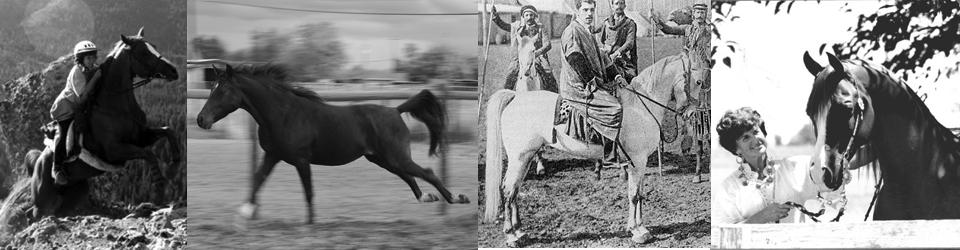
Arab Families (1950)

by GRACE DASHIELL (Western Horseman June, 1950) There are definite and noticeable variations in the conformation of Arabian horses. Most of these can be traced to the influence of the three main family strains. The Muniqui strain seems to be responsible for the tendency of many modern individuals to fall short of the standard of perfection we like to see in the Arab. This strain has been mixed for …

Continue reading →

Preservation Breeding and Population Genetics

by Michael Bowling © 1995 from CMK Record XI/2 Spring '95 (This discussion is based on outline notes for the talk I gave at the 1994 Annual Meeting of the Arabian Horse Historians Association. The timeliness of the topic is underscored by a comment from the outgoing AHHA president, Carol Schulz, that at least 90% of the Arabian foals registered in the last several stud books are of generalized …

Continue reading →

CID: The Paradigm has Shifted

CID: The Paradigm Has Shifted COPYRIGHT 1997 By MICHAEL BOWLING from Arabian Visions magazine Sept/Oct 1997 used by permission of Michael Bowling Author's note: This piece illustrates the vitality of a new communications medium, for it grew primarily out of Internet discussions of the subject. Special thanks to Mary Anne Grimmell who planted the seed of "putting into laymen's …

Continue reading →

The Arab Horse in Legend and History

by Dr. Amin Zaher Photos from the Zaher collection (Western Horseman Mar/Apr'48) Nigma at 5 yrs. with her first colt in Egypt. Picture taken in front of Prince Mohammed Ali's palace. Amir Abdelkader Algazairy, a nineteenth century Morroccan nobleman, tells us that some Arabs of the Azed tribe went to Jerusalem to congratulate Solomon on his marriage to the Queen of Sheba. Having completed their …

Continue reading →

An Introduction to the Author, Dr. Amin Zaher

From "This Issue and Next" (Western Horseman Mar/Apr'48) Dr. Amin Zaher, D.V.M., M.S., has recently come to the United States from Egypt to obtain a PhD. in genetics and animal breeding. His thesis title is "The Genetic History of the Arab in America." Prior to his arrival in the states he occupied the position of Arabian horse breeder in the stud of the Royal Agricultural Society of Egypt for …

Continue reading →

My Visit with the American Arabs (Horses)

by Dr. Amin Zaher Photos from the Zaher collection (Western Horseman Jul/Aug '48) The Van Vleet Arabs on their high altitude ranch, not far from Denver, Colorado. While I was in Egypt, I read much about the American-bred Arabs. When I had the opportunity to come to this country to study, it was my honor to be asked by the Egyptian government to make a tour and to inspect these Arabians in America. …

Continue reading →

Working Arabs in the Northwest

by Ralph H. Smith (Western Horseman Apr '51) We fellows up here in Montana and Wyoming have a yen for good horse flesh, the same as they do in Texas or California, especially after the jeep can't cross a washout or take up through the timber on a mountainside. Most Northwestern ranchers run cattle, sheep or horses on summer range in the Forest Reserve high in them mountain ranges, adjacent to our …

Continue reading →

Maidan

From The Khamsat Vol 9, Num 4, Nov/Dec '92 excerpted from The Arab Horse Spencer Borden, New York, 1906 Maidan at 23 from The Arab Horse Maidan is the last of the great horses that came to England from Arabia through India, whose name can have our especial attention. Many who knew him, including Lady Anne Blunt and the Hon. Miss Dillon, place him even above Kismet, and the opinion is concurred in …

Continue reading →

Arabia, and some of the Bedouins from The Arab Horse Chapter II

Articles of History: Voices from the Past See Also: Maidan CHAPTER VI - SOME LAST WORDS From: The Arab Horse Chapter II Arabia, And Some of the Bedouins by Spencer BordenNew York, 1906 from the Khamsat VolumeFoun Number Three August 1987 At the northeastern courner of the Mediterranean Sea, just below the point where the southern coast of Asia minor joins the western coast of Syria, lies the town …

Continue reading →